Monches Farm, LLC
5890 Monches Road
Colgate, Wisconsin
phone: 262-966-2787
| BUTTERFLIES! |
| |
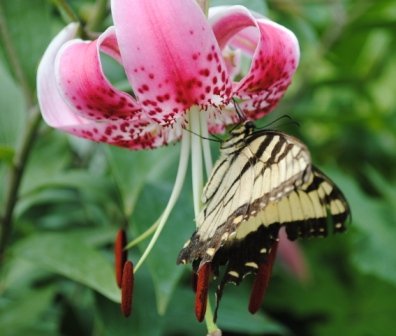
| August , 2011 We and our visitors at the Farm are enjoying an abundance of varied butterflies this summer. They love the banquet of nectar sources they find here. They are especially attracted right now to Asclepias incarnata (Swamp Milkweed), Monarda (Beebalm), Lilies , Eupatorium (Joe Pye Weed), Lobelia (Cardinal Flower) and Nepeta (which is also a favorite of the funny little Hummingbird Moth ). With their wild habitat rapidly diminishing, butterflies rely more and more on our gardens to survive. By selecting plants that are favored as both nectar sources for adults (butterflies) as well as food sources for “babies” (caterpillars) you can create an oasis for these delightful creatures in even a small urban space. Try to plan for a sequence of bloom to keep your winged visitors around throughout the season. Late and early season nectar sources can be the most valuable since at either end of the growing season nectar sources may be more difficult to find. Many immature butterflies (caterpillars) are very specific in their food requirements, often limiting their diet to a single Genus. This can threaten their numbers when that plant becomes difficult to find. An excellent example of this phenomenon is the Pipevine Swallowtail butterfly. This butterfly relies solely on a single Genus (Aristolochia) as a food source in its larval stage. In the days prior to air conditioning it was very popular to plant the large leaf, fast growing Dutchman Pipe Vine (Aristolochia macrophylla/durior) to climb over and shade outdoor porches. People would then sit on their porches in the evening, enjoying the shade and whatever breeze they could find outdoors as relief from the sweltering interior of the house. With the advent and increased popularity of air conditioning these evenings on the shaded front porch diminished and have now all but disappeared, and with them the Aristolochia vines and the Pipevine Swallowtail butterfly. In this area it is now quite rare to see a Pipevine Swallowtail butterfly. We, however, do have them at Monches Farm because we have - tangling around the entire front of the shop - an Aristolochia vine! There have been times when it has been so heavily populated with larval Swallowtails that we’ve had to post signs explaining to distressed customers that YES, we DO want those ugly caterpillars as they will soon become exquisite butterflies ! Following is a list of some of the perennials & annuals that attract butterflies. Perennial nectar sources for butterflies: Achillea (Yarrow) Allium (Ornamental Onion) *Asclepias (Milkweed/Butterlyweed) *Aster Buddleia (Butterfly Bush) Coreopsis Echinacea (Purple Coneflower) Echinops (Globe Thistle) *Eupatorium (Joe Pye Weed) Gaillardia (Blanket Flower) Hemerocallis (Daylily) *Liatris (Gayfeather/Blazing Star) Lily Lobelia Nepeta (Catmint) Phlox Pycnanthemum (Mountain Mint) *Rudbeckia Sedum Silphium Solidago (Goldenrod) Vernonia (Ironweed) Annual
nectar sources for butterflies: Ageratum (Floss Flower) Cosmos *Lantana *Pentas Marigold Tithonia (Mexican Sunflower) Nicotiana Petunia Verbena Zinnia Food plants for “Baby” butterflies (caterpillars): Aristolochia (Dutchman Pipe Vine) Asclepias (Milkweed/Butterfly weed) Aster Beans Cassia (Wild Senna) Chelone (Turtlehead) Fennel Humulus (Hops Vine) Lupine Malva Parsley Polygonum Sedum Snapdragon Trifolium (Clover) |